
|
Huizhou architecture featured at Heritage Museum
The art of Huizhou architecture is now featuring at the Hong Kong Heritage Museum until July 1, 2005.
The exhibition showcases a selection of models, component parts of buildings, artifacts and furniture from Anhui Provincial Museum.
Jointly presented by the Leisure and Cultural Services Department and the Anhui Provincial Museum, the "Huizhou Vernacular Architecture" exhibition displays more than 120 sets of exquisite wood, brick and stone carvings from Huizhou. Along with a reconstruction of a main hall and a study room of a typical Huizhou dwelling, the exhibition enables the visitors to get a better understanding of traditional Huizhou, its beauty and cultured elegance, as well as a taste of the idyllic enclave.
Under the jurisdiction of Huizhou is the mountainous region of Southern Anhui, covering the Yellow Mountain, Qiyun Mountain and the upper reaches of Xinan River. Its unique geographical environment provided the migrant officials and scholars a safe haven from wars and other upheavals, and an idyllic pastoral setting in which to live and indulge in the beauty of nature. 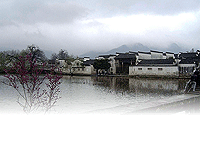
Huizhou dwellings are embraced by attractive natural environment
Among the various local dwellings, the renowned villages of Xidi and Hongcun were listed as the world heritage by the United Nations Educational, Scientific and Cultural Organisation (UNESCO) in 2000.
Huizhou architecture is the embodiment of the aesthetic and ethical values of the region, evolving from the geographical settings of the area. It reflects the Confucian upbringing of the Huizhou merchants, whose practical wit blended perfectly with a serene sense of elegance. 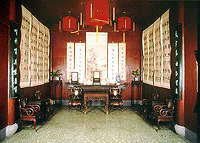
The setting of the main hall reflects the traditional and cultural values of Hui people
Most of the villages in the region are set in a north-south orientation, facing their water source and a mountain barrier to the rear. The whitewashed walls topped with grey tiles, the soaring tiered gables and the high enclosing walls are all typical features.
The courtyards are mostly surrounded by buildings in multiple, symmetric rows. Portraits of ancestors are hung in the main halls, together with paintings and calligraphies of renowned masters -- all very typical of the Confucian legacies of Huizhou. The courtyards adjoining the main halls are sources of light and ventilation. Rainwater is gathered and drained from these courtyards, taking on the propitious meaning of "all waters converge at the hall", denoting the accumulation of wealth and happiness. The ancestral halls, memorial archways and gardens too, are manifestations of the art of Huizhou architecture.
Decorative brick, stone and wood carvings, the renowned "Three carvings" of Huizhou traditional dwellings are focal features which add to the charms of its architecture. Such carvings are commonly seen on dwellings, ancestral halls and memorial archways, door canopies, columns, brackets, beams and window panels. 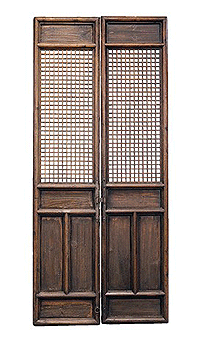
Lattice panels, Ming dynasty (1368-1644)
Apart from being pragmatic architectural components, the carvings provide details of aesthetic interest to the buildings. The subjects of the carvings varied from landscapes and folklores to the more popular historical anecdotes, scenes from folk operas and auspicious motifs, all part and parcel of the aesthetic and values of the Huizhou people. 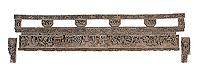
Door canopy decoration depicting scenes of spring outing
For details of he exhibition, visit the Heritage Museum's website at http://hk.heritage.museum/english/exhibition.htm
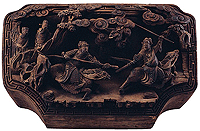
Support block between beams with characters from The Romance of the Three Kingdom
|