
|
Misguided concerns on Article 23 proposals clarified
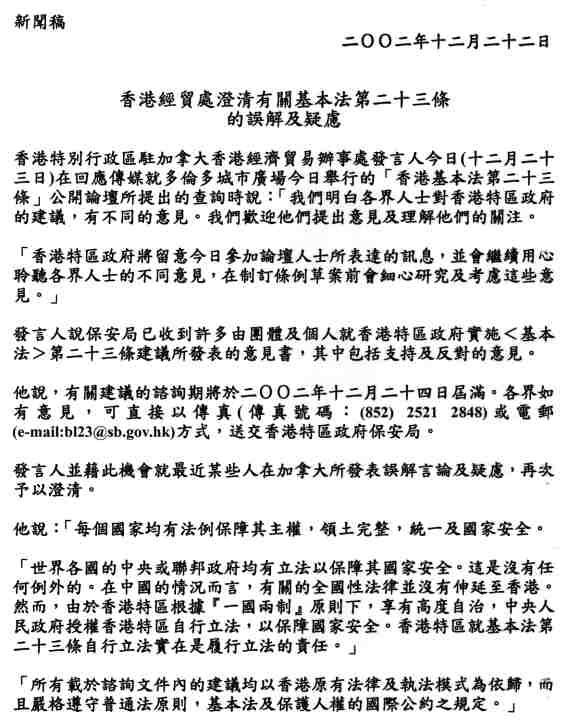
Press Release - December 22, 2002
In response to media enquiries about today�s (December 22) public forum held at Market Village in Toronto on Article 23 proposals, a spokesman for the Hong Kong Economic and Trade Office (Canada) said: �We note that different views have been expressed over the proposals. The Hong Kong Special Administrative Region Government (HKSARG) welcomes the expression of opinion and is sensitive to people�s concerns.
�The HKSARG will take careful note of the views expressed today and will continue to listen to different views from various sectors. All these views will be carefully studied and considered before formulating the draft legislation.�
The spokesman noted that as at yesterday, the Security Bureau of the HKSARG had received many submissions from organizations and individuals in response to government proposals to implement Article 23. They include expressions of support and opposition.
He said that the consultation period would end on December 24, 2002. Comments on the proposals can be sent to the HKSARG Security Bureau by fax at (852) 2521 2848 or by e-mail at [email protected].
The spokesman took the opportunity to clarify once again some of the misguided and misinformed viewpoints and concerns as expressed recently by some people in Canada.
He said: �Every nation has laws to protect its sovereignty, territorial integrity, unity and national security.
�National security laws are almost without exception enacted by central or federal governments. In the case of China, the national laws on these subjects do not extend to Hong Kong. In line with the high degree of autonomy for the HKSAR under the �One Country, Two Systems� principle enshrined in the Basic Law, Hong Kong has been given the responsibility to enact its own laws to fill the gap that would otherwise arise. It is a constitutional duty for HKSARG to legislate.
�All the proposals as contained in our consultation paper are home-grown and based on existing Hong Kong legislation. They are constructed strictly in accordance with common law principles, the Basic Law and international covenants on the protection of human rights.�
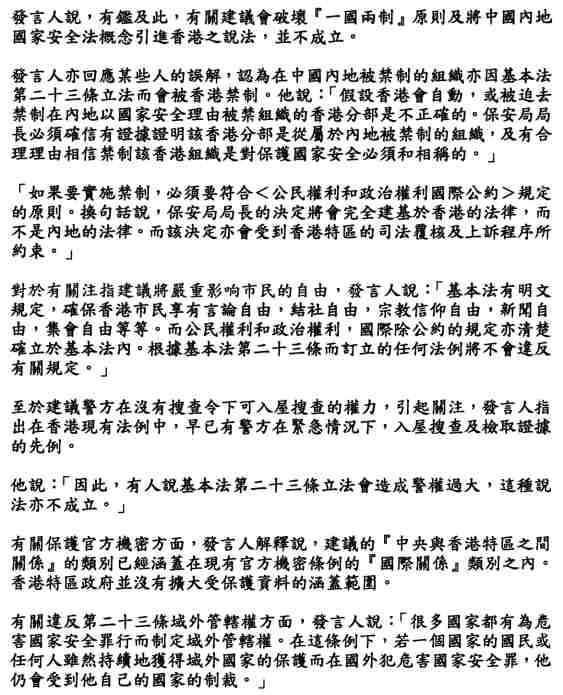
The spokesman said there was no question of the proposed legislation destroying the �One Country, Two Systems� principle or extending Mainland concepts of national security to Hong Kong.
On the misguided belief that organizations banned by the Chinese government can be banned in Hong Kong, the spokesman said: �It is incorrect to assume that Hong Kong would automatically, or be obliged, to ban the local branch of an organization outlawed in the Mainland on national security grounds. The Secretary for Security must be satisfied by evidence of the local branch�s subordination to the banned Mainland organization and must reasonably believe that it is necessary and proportionate in the interests of national security to ban the affiliated Hong Kong organization.
�If a proscription is to be imposed, it must be done in accordance with the standards stipulated under the International Covenant on Civil and Political Rights (ICCPR). In other words, the Secretary for Security�s decision will be based entirely on the laws of Hong Kong and not the Mainland�s. And the decision is subject to judicial review and appeal mechanism within the HKSAR.�
Addressing the worries that the proposals would adversely affect people�s freedom, the spokesman stated: �The Basic Law expressly guarantees that Hong Kong residents shall have the freedoms of expression, association, and religious belief, freedom of the press, freedom of assembly, etc. The ICCPR is also constitutionally enshrined in the Basic Law. No law enacted under Article 23 shall contravene these constitutional rights.
As regards the concern over proposed extended police power to enter homes without a search warrant, the spokesman pointed out that the proposed investigation power of entry and search already existed for a number of offences in the existing law, and are subject to strict conditions.
�There is no question of Hong Kong becoming a �police state�,� he said.
On the protection of official secrets, the spokesman explained the proposed category of �Relations between the Central Authorities and the HKSAR� was already covered by the present category of �International Relations� in the Official Secrets Ordinance. There is no broadening of the scope of information protected.
On the question of extra-territorial application, the spokesman said: "Many jurisdictions provide that offences endangering national security have extra-territorial application. On that basis, if a country�s national or someone under the continuing protection of a country commits such offences in a place outside his country, he would still be triable by his country.�
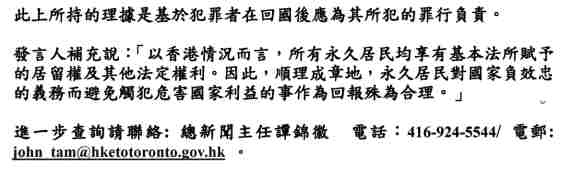
The rationale of such an approach is that the offender should be held responsible on his return to the country for such offences.
�In the case of Hong Kong, the permanent residency status carries with it the right of abode and other constitutional rights as guaranteed under the Basic Law. It is only reasonable that the rights and protection enjoyed by a permanent resident should be reciprocated at least by abstention from actions endangering the vital interest of the state,� the spokesman added.
For more information, please contact:
John Tam, Chief Information Officer of Hong Kong Economic and Trade Office at: (416) 924-5544 or email: [email protected].
|